The Expectation Gap: Why a Joke Needs a Clear Setup
A clear joke setup points readers toward one likely meaning, giving the punchline room to redirect it without a long explanation or a strained surprise.
A clear joke setup gives readers a likely interpretation before the punchline turns it aside. That expectation gap is the engine of many jokes: the setup supplies enough information to make one reading feel natural, then the punchline reveals a more surprising reading that still fits the words. If the setup is muddy, readers cannot tell what they were supposed to expect, and the surprise has nothing firm to push against.
This is why a setup is not simply the sentence before the funny sentence. It is a small act of guidance. It selects a subject, establishes a context and quietly narrows the reader’s guesses. The writer does not need to explain the joke’s destination. The writer needs to make the wrong destination attractive.
What does a clear setup make readers assume?
A setup creates a provisional picture. It might lead readers to expect a familiar situation, a conventional response or a particular meaning for an ambiguous word. The punchline then changes one part of that picture. The turn can be modest; it only has to make the reader revise an assumption they were already making.
Consider: “I told my landlord the apartment had a draft. He sent over a novelist.” The first sentence points toward a leak of cold air. “Draft” also means a preliminary version of writing, and the landlord’s response makes that second meaning suddenly relevant. The line works because the apartment context first favors one meaning, while the punchline supplies a person associated with the other.
There are two useful tests hidden in that example. Before the punchline, can a reader form a fairly specific expectation? After it, can the reader see how the new meaning connects to the setup? If the answer to the first is no, the setup may be too vague. If the answer to the second is no, the punchline may be a surprise without a satisfying turn.
How much information belongs in the setup?
Enough to establish the premise and support the turn; no more by default. A setup can identify who is speaking, what has happened and which detail will matter. It does not need to include every piece of background that helped the writer invent the joke. Readers should receive the information needed to follow the first interpretation, not the writer’s private route to the punchline.
Imagine you are writing about a character who takes a cooking class because they want to impress a date. The useful setup may be that the character is a beginner and has misunderstood the class description. A paragraph about the character’s entire dating history probably does not help the eventual turn. If the punchline depends on the instructor mistaking “make a good impression” for a lesson in printing, establish the phrase or context that makes that misunderstanding plausible. Keep the rest out of the reader’s way.
Compression is not the same as clarity. A very short setup can be cryptic if it leaves out the relationship that makes the punchline legible. Conversely, a longer setup can work if each detail strengthens the expected interpretation or makes the later redirection feel earned. The practical question is not “Can this be shorter?” but “Does this detail help the reader picture the setup, anticipate the likely outcome or understand the turn?”
Which expectation is the punchline redirecting?
Writers often think of a punchline as a surprise, but surprise alone is cheap. A sentence about a purple canoe arriving in a courtroom may be unexpected; without a setup that makes the canoe relevant, it is merely an interruption. A stronger punchline redirects an expectation the setup has actually encouraged.
Common routes include a second meaning for a word, a reversal of cause and effect, an unexpectedly literal response, a change in scale or a shift in what a character considers important. These are not recipes. They are ways of describing the reader’s adjustment: “I thought the speaker meant this; now I see they meant that,” or “I expected this consequence; the character treats another consequence as the problem.”
For instance, a setup about a person bringing a ladder to a job interview may suggest an odd practical choice. A punchline could reveal that the applicant believes “moving up in the company” is a physical task. The comic turn depends on the phrase’s ordinary figurative meaning and the character’s literal reading. If the setup instead spends several lines on an unrelated interview mishap, the phrase may arrive without enough support to carry the joke.
The reader should be able to connect the two interpretations after the turn. That connection need not be realistic in a strict sense; comic logic can be foolish. It should, however, be visible. A punchline that depends on a hidden fact, an obscure reference or an unstated rule asks readers to do reconstruction before they can enjoy the redirection.
What should you check before revising a joke?
Use these checks to locate the exact point where the reader may lose the line:
- Identify the first reading. Write down what a reader is likely to picture before the punchline. If you cannot name it, clarify the setup’s context.
- Circle the pivot. Find the word, phrase or assumption that changes meaning. If nothing in the punchline turns the setup, the line may rely on random surprise.
- Check the connection. Ask how the punchline follows from the setup under its new reading. Add only the missing information needed to make that link legible.
- Remove private backstory. Cut details that explain why you thought of the joke but do not shape the reader’s expectation or interpretation.
- Read the setup on its own. It should establish a coherent situation, even if it is not yet funny. If it sounds like a list of clues, add the relationship among them.
- Read the punchline without explanation. If you need to append “because what I mean is…” the turn may not be clear enough, or the setup may be pointing in the wrong direction.
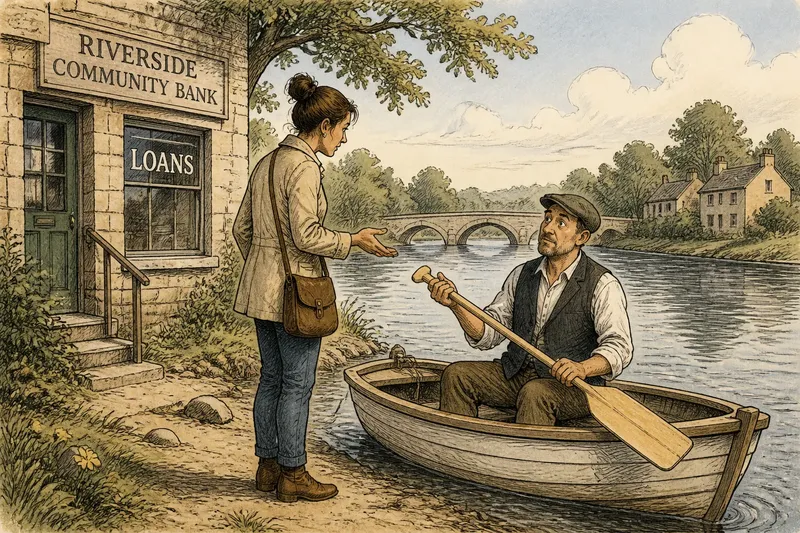
Say you have written, “Mara went to the bank to ask about a loan. The clerk offered her a paddle.” The setup suggests a financial institution and a request for money, but the punchline switches to a riverbank without preparing that setting. If you want the turn to hinge on “bank,” revise the setup so the second meaning can plausibly emerge, perhaps by establishing that Mara is standing beside a river and speaking to someone who mistakes her request. The observable result should be that readers can recognize the intended double meaning at the punchline, rather than needing a note afterward. If that context makes the line cumbersome, choose a different pivot instead of piling on explanation.
Why do some clear setups still produce weak jokes?
Clarity makes the turn possible; it does not make the turn worthwhile. A setup can point cleanly toward an obvious punchline, leaving readers with little to revise. Or the punchline can technically change the meaning while offering no sharper image, character insight or comic consequence. The gap needs a destination that rewards the reader’s adjustment.
One way to strengthen a familiar turn is to make its consequence specific. A general joke about someone misunderstanding a phrase may feel interchangeable. A detail that belongs to this speaker, setting or problem can give the reversal texture. The detail should not become an extra explanation. It should make the newly revealed interpretation more vivid or tell us something amusing about the person involved.
Another weakness is a setup that signals its own trick too loudly. If a sentence leans heavily on a conspicuously ambiguous word, readers may begin searching for alternate meanings before the punchline arrives. That can still work when anticipation is part of the pleasure, but it reduces the surprise. Sometimes the better setup sounds ordinary and lets the punchline make a previously unremarkable word look different.
It is also possible to over-correct. Writers may keep adding context until every possible misreading has been removed, then discover that the joke has no room to turn. A reader does not need every uncertainty resolved. The useful distinction is between uncertainty about the situation, which can block comprehension, and uncertainty about what will happen next, which can support comedy.
How do setup and punchline work together?
Think of them as one compact piece of reasoning. The setup says, in effect, “Given this situation, you may expect this.” The punchline says, “Here is another interpretation, and it changes the situation.” The second sentence should not merely arrive later; it should alter how the first sentence is understood.
When revising, try writing the expected reading in plain language, then write the punchline’s alternate reading beside it. If the two are nearly identical, the gap may be too small. If they have no meaningful connection, the gap may be too wide. The useful middle is an unexpected shift that readers can trace backward through the wording.
Not every joke needs an elaborate setup, and not every punchline needs a double meaning. A short exchange can establish its expectation through a single concrete detail. A longer comic story can build context gradually, but each added detail should keep the reader oriented toward the eventual turn. The central craft choice remains the same: decide what the reader is likely to assume, then give the punchline a clear reason to make that assumption wobble.
For a quick edit, mark the setup’s most likely interpretation and the punchline’s new one. That small note often reveals whether the problem is missing context, excess explanation or a turn that never quite turns. A clear expectation gap does not explain the joke for the reader; it gives the reader enough footing to enjoy changing their mind. That is the useful standard for a clear joke setup.