From Mix-Up to Exit: Building a Sketch with Escalation
Sketch escalation turns one mix-up into a comic arc, helping each beat change the characters’ choices and giving the scene an ending that lands.
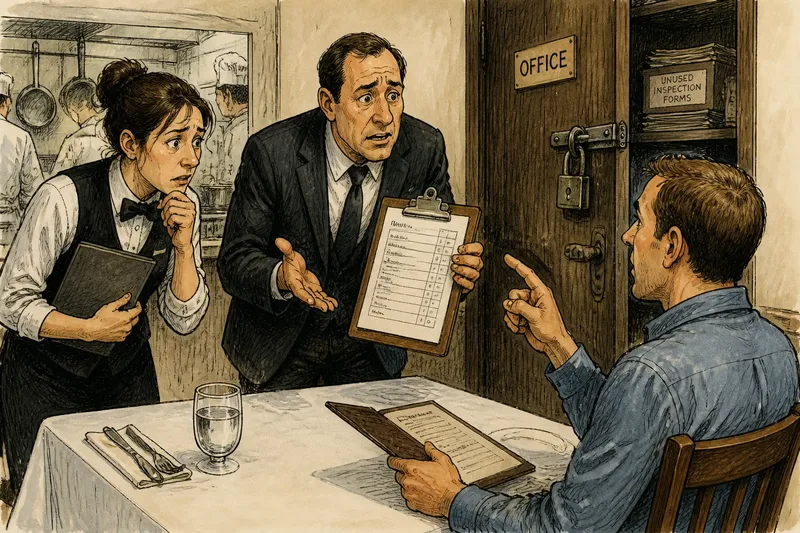
Sketch escalation works when a mistaken identity forces characters to make new choices, not merely repeat their first objection at greater volume. A customer mistaken for a health inspector can start as a small service problem; each attempt to manage the mistake can then alter who is involved, what is at risk, or what the audience understands.
Build the scene around those changing pressures. The goal is not to make every beat bigger, but to make the next beat different in a way the characters have caused.
How can one mix-up sustain sketch escalation?
Choose a complication that gives each character a reason to act. A restaurant staff that mistakes a customer for an inspector wants to appear prepared; the customer wants lunch. Those aims collide as soon as the staff begins treating ordinary requests like an examination.
Keep the first response small enough to leave room for change. A server might offer a spotless table and an unusually formal menu. That establishes the mistaken identity without spending the entire scene on a full-scale panic.
From there, track how the characters’ choices reshape the situation. The staff hides the daily special to avoid scrutiny, so the customer asks why the menu is incomplete. The manager brings out an inspection form to reassure the customer, so now the staff must explain a document the customer never requested. The comic material comes from the new problem each attempted fix creates.
What should each beat change?
Give every beat a specific change in the scene’s available choices. A beat can widen the circle of people involved, expose a new detail, make the original plan harder to sustain, or transfer control to someone unexpected.
Imagine a draft that begins with a server mistaking a diner for an inspector. The manager stages a kitchen tour, but the diner asks for the restroom key. The staff has kept it in a locked office to hide a stack of unused inspection forms, so the manager must choose between admitting the odd system and inventing another excuse. The starting mix-up has now produced a new choice and a more revealing problem; the scene need not rely on louder objections.
One useful drafting prompt is, “Because that happened, who must do what now?” If the answer is simply “the same person reacts again,” the beat may be repeating the scene rather than changing it. A new gag can still fit, but it should alter the situation or reveal something that affects what follows.
How do you make escalation feel earned?
Let a character’s motive explain each ill-advised action. The manager hides the forms because they want to look competent, not because the story requires a locked office. The audience can follow the impulse even while seeing its likely cost.
Escalation can also change in kind. The trouble might spread from the server to the whole staff, move from public embarrassment to a personal stake, or shift control to the customer. A quiet, awkward admission can raise the pressure more effectively than another round of frantic hospitality.
Keep the audience’s knowledge readable. If viewers know the customer is ordinary while the staff remains convinced otherwise, the gap can sustain the scene. If the customer’s identity is genuinely uncertain, make that uncertainty legible too. The audience should be able to tell what each person believes, even when the characters are making a mess of it.
How can you tell whether a sketch ending is decisive?
What makes a final beat different from another escalation?
A final beat settles the immediate contest or makes its cost unmistakable. If the customer finally says they only wanted lunch and the manager responds by handing over the inspection form, the scene has reached a distinct outcome rather than another attempt to impress.
Should the misunderstanding be explained at the end?
Explain only what the audience needs to understand the action. A brief correction can close the information gap, while a long account of how the mistake began usually delays the exit.
When should you cut a repeated beat?
Cut or combine a beat when it leaves the same people with the same options and adds no useful information. If the staff has already hidden the menu and staged a tour, a third display of excessive politeness needs a new consequence to earn its place.
Does the scene need a reversal?
No. A reversal helps when it grows from the mix-up and changes the characters’ understanding or control. A surprise identity that has no effect on the choices already in play is an extra premise, not a stronger ending.
What is not worth the effort?
There is little value in listing every possible gag before the characters have a reason to act. An elaborate prop or last-minute identity reveal cannot supply a comic progression by itself. Find the pressure created by the mix-up, then keep the actions that change it.
What does a worked escalation look like?
Say you are drafting a short restaurant sketch. The starting inputs are a server who mistakes a diner for a health inspector, a diner who wants soup, and a manager who fears the restaurant will look unprepared. First, the server offers a spotless table and watches the diner’s reaction. Next, the diner asks why the daily special is missing, so the server hides the menu and calls the manager. The manager then produces an inspection form to look organized; the diner asks for the restroom key instead. Because the key is kept in the office with the unused forms, the manager must either admit the odd system or keep the diner waiting while inventing another excuse.
For the ending, choose the admission: the manager says the forms are old and the key is in the office, then hands it over. The observable result is that the misunderstanding ends through an action, while the staff’s fussiness has become the scene’s final cost. A larger reveal is not needed; it would add another turn without improving this one.
Sketch escalation is easiest to judge by asking whether each beat changes the problem, the characters’ options, or what the audience knows. For this restaurant sketch, the locked-office detail supplies the last useful complication; once the manager admits it and gives up the key, the scene has a clean exit. The next joke can wait for another sketch.